Production Performance Brief
Choose a Water Bottling Line Arrangement That Supports Your Output
The same headline filling speed can sit inside very different production systems. Compare where supply, stops, recovery and shared resources limit the finished output.
Direct answer
How should a buyer choose a water bottling production-line capacity arrangement?
Review point 01
Choose the bottle-supply route on continuity, not one machine rating
Purchased empty bottles move the bottle-making process outside the line, but receiving, feeding and container handling still have to sustain production. On-site blowing adds control over bottle supply while introducing preform, mold, utility and maintenance dependencies. Compare these routes using approved bottles and the same shift requirement, including replenishment and changeover. Do not assume a catalog bottle-volume range proves every shape will run.
- For purchased bottles, confirm usable supply, feeding behavior and handling of interrupted deliveries or replenishment.
- For on-site blowing, confirm the approved preform/bottle combination, actual output basis and point-of-use utility conditions.
- Identify which equipment is proposed, retained or outside supply. This guide compares arrangements, not a promise that every option is included.
Review point 02
Compare close coupling with controlled separation
A closely coupled block can reduce intermediate transfers; separate machines allow an intermediate conveyor or accumulation strategy and may suit retained equipment. Neither arrangement is inherently the higher-output choice. Ask what stops together, what may continue temporarily, and what is required to recover after the interruption. Conveyor length has no protective value unless bottle stability, available space and controls make it usable under the agreed conditions.
- Compare normal running, a short upstream interruption and a short downstream interruption using approved supplier/site procedures; do not bypass safeguards to test the concept.
- Check access, supported formats and the scope of a changeover across the connected equipment, not just the number of machines.
- Use the line-balance calculator for comparable rates and the buffer guide for the protection/recovery calculation rather than assuming a fixed speed margin.
Review point 03
Expose shared resources before adding parallel capacity
Two filling branches do not provide two independent finished-output paths if they share packing or another limiting service. Independent arithmetic illustration: two branches are each declared at 3,000 bottles/hour for the same format, giving 6,000 bottles/hour before a shared packer. A packer declared at 450 packs/hour with 12 bottles per pack represents 5,400 bottles/hour. Under these stated ideal rates the shared stage cannot support both branches at their full combined rate; losses and quality treatment can reduce accepted output further.
- The figures are invented for comparison, not Allot Tech machine ratings or customer test data.
- If the shared packer stops, both branches may be affected when their usable accumulation is exhausted; two branches alone do not prove redundancy.
- When different SKUs share a resource, account for their schedules, changeovers and permitted routing rather than simply adding capacities measured on different products.
Review point 04
Choose on a comparison basis that can be demonstrated
Ask each proposal to show the same required output boundary, bottle/pack mix, supplied and retained scope, shared resources and open assumptions. An expansion-ready arrangement should identify the later connection, downstream reserve and any utility or controls changes still needed. A drawing with free floor space is not enough to establish expansion capacity. Select the option whose claimed behavior is supported by relevant evidence and whose unresolved conditions can be closed.
- Separate demonstrated performance, supplier-declared values and conditions still needing verification.
- Use the performance specification to record deviations and acceptance requirements; do not turn this guide into a guaranteed operating rate.
- For a line review, provide the target accepted output, proposed arrangement, retained machines and the specific choice you need to make.
| Arrangement under consideration | Why it may fit | What must be verified |
|---|---|---|
| Purchased-bottle feeding | Bottle production is outside the connected machinery scope. | Usable supply and feeding continuity for the required bottle and schedule. |
| Separate blowing and filling | The project needs separate modules, retained machines or an intermediate transfer strategy. | Compatible rates, usable accumulation, transfer behavior and coordinated recovery. |
| Closely coupled equipment | The proposed design reduces intermediate handling between selected operations. | Supported formats, common-stop behavior, access and restart performance. |
| Parallel branches with shared packing | A proposed expansion shares a downstream operation. | Combined demand, shared-stage capacity, scheduling and the effect of a common stop. |
Catalog equipment evidence
See the machines behind this production-line question.
These Allot Tech catalog references connect the technical explanation to physical equipment. Each caption identifies the capacity, interface or acceptance evidence to confirm.
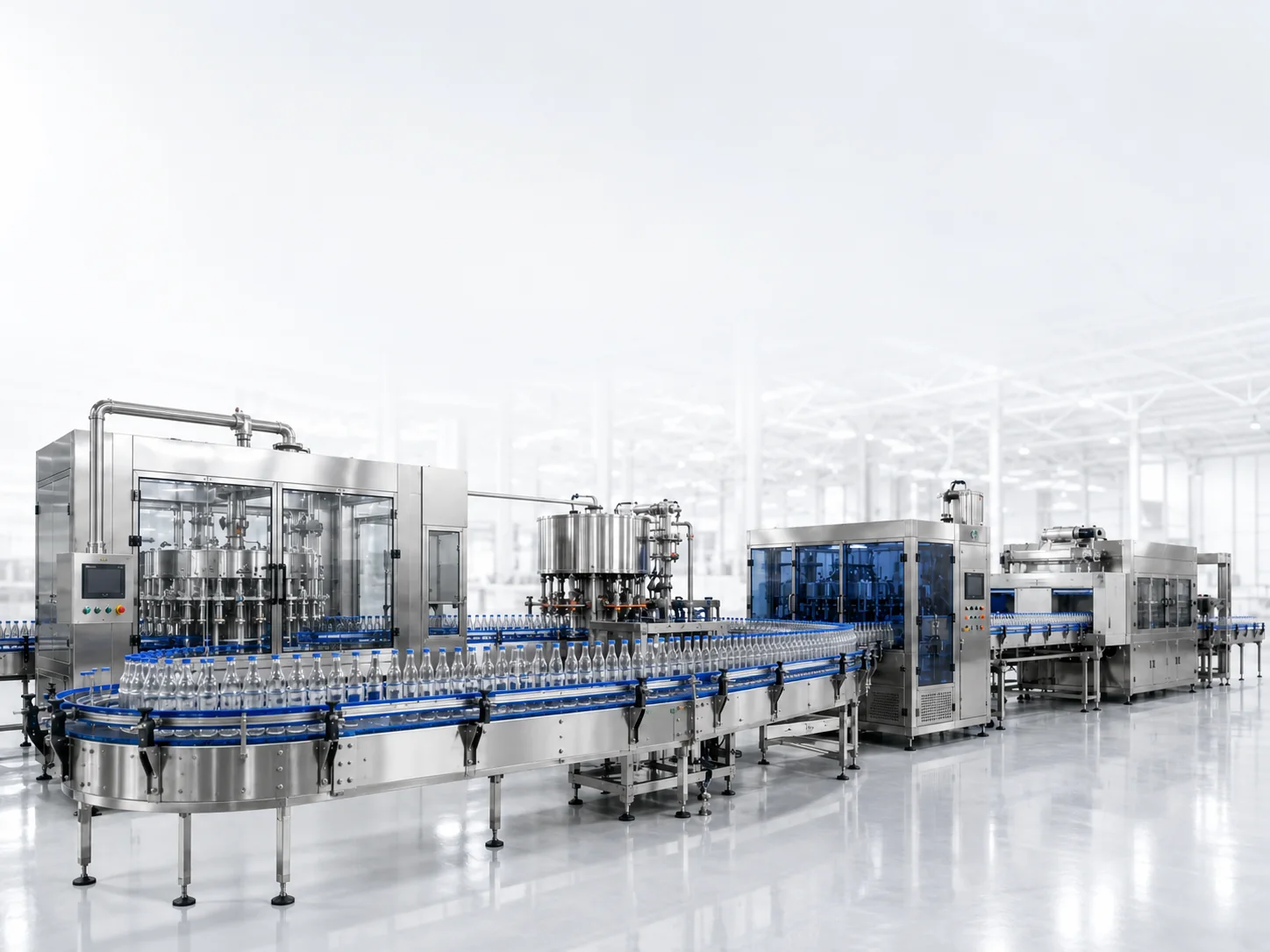
Connected water bottling line
Use the complete-line view to mark machine boundaries, transfer points, utilities, controls and output counting locations.
Review this interface basis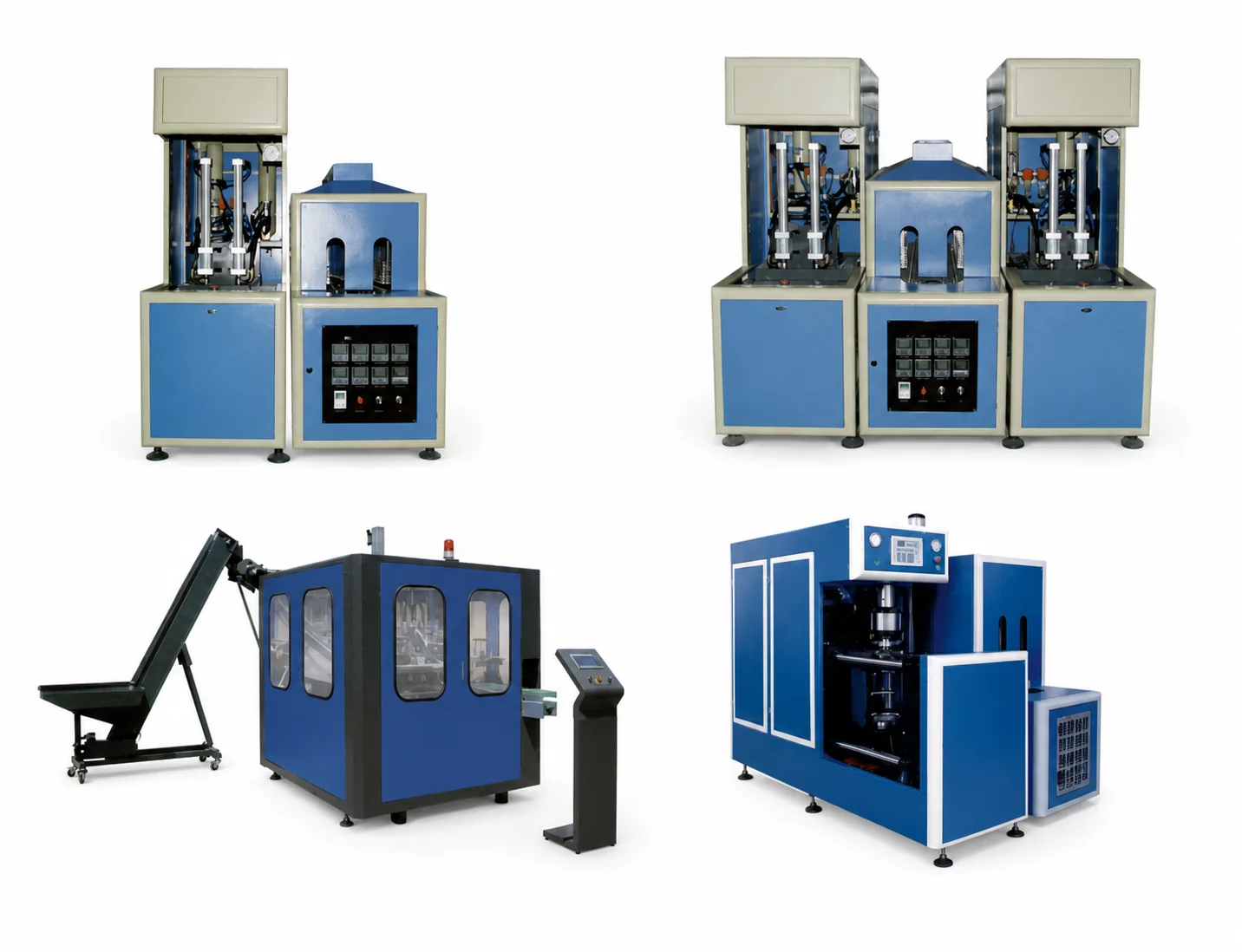
PET bottle blow molding
Accepted bottle output depends on the approved preform, bottle geometry, mold, recipe, high-pressure air and cooling.
Review this interface basis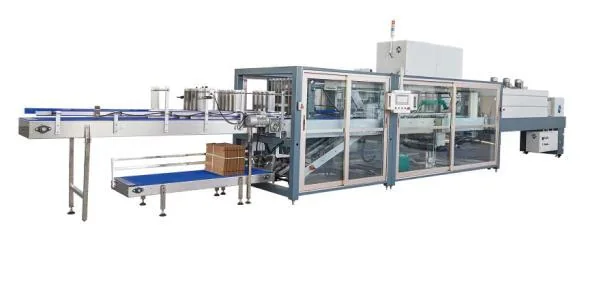
End-of-line packing system
The packer is one connected capacity node; pack pattern, cycle, bottle behavior and discharge flow set the usable rate.
Review this interface basisSource: Allot Tech Beverage Bottling Catalog 2026. Images are representative equipment references; final models and configurations remain project-specific.
Questions before specification
Frequently asked questions
Answers are planning guidance. Project requirements and performance remain subject to confirmed data and agreements.
Is there a fixed BPH range for each arrangement?
No. The bottle, pack, process, equipment configuration and operating conditions determine suitability. Use comparable project data rather than a universal compact, medium or high-speed threshold.
Does adding a second filler double complete-line output?
Not necessarily. Shared bottle supply, packing, utilities or handling can constrain the combined flow. Compare the full connected route and confirm the accepted-output boundary.
Is an integrated block always better than separate machines?
No. Integration and separation create different transfer, access, changeover and stop-recovery dependencies. Compare actual supported configurations and evidence for your project.
Next buyer step