Production Performance Brief
Water Bottling Process Flow: Follow the Product and the Output
Read a water bottling line as two preparation streams that meet at filling, followed by the operations that turn filled bottles into accepted finished packs.
Direct answer
What are the main stages in a water bottling production process?
Review point 01
Map the two preparations before their convergence
The water route starts from the actual source and required finished-water condition. The applicable treatment, storage and transfer arrangement must deliver suitable product water at the filler connection. Separately, the container route supplies approved empty bottles, either purchased or blown on site from approved preforms. Caps arrive through their own supply route. A running filler cannot create output if any required input is unavailable.
- Use the water analysis and approved process requirements to define treatment; this flow guide does not prescribe a universal filter, disinfection or cleaning recipe.
- Show purchased-bottle feeding or on-site blowing as the selected route, not two compulsory machines in every quotation.
- Mark the bottle/preform, neck and closure revisions and the actual container-preparation step specified for the project.
Review point 02
Follow the filled bottle all the way to the agreed finish
Filling and capping create a closed bottle, not automatically an accepted finished pack. The next operations may include checking fill and closure conditions, applying or checking labels and codes, collating bottles and forming film packs or cases. Pallet handling belongs inside the performance boundary only when that is part of the agreed output requirement. Place every applicable check and rejection point at its actual location; inspection and coding order should not be inferred from a generic diagram.
- Name the condition handed to the next operation: bottle stability, surface condition, approved closure, label/code or completed pack, as applicable.
- Separate label, film, case and cap replenishment from the main bottle path so material shortages remain visible.
- Mark pack discharge and pallet discharge separately when both are relevant; a filled-bottle counter cannot prove either downstream result.
Review point 03
Put meaningful count points on the flow
Record what each counter counts, its unit and its physical position. An upstream bottle count may include units later rejected, held or still between machines. A pack counter must state the actual bottles per pack and whether the pack has passed the agreed checks. As a simple unit illustration, 240 accepted packs of 12 bottles represent 2,880 accepted bottles at that pack boundary; that alone says nothing about the observation duration, upstream reject quantity or another SKU.
- Use the same start and end times when comparing stages; preserve beginning and ending unfinished inventory where it affects reconciliation.
- Show reject and hold routes separately. Returned or reintroduced units need an identified count treatment, not an unmarked arrow back into the flow.
- Use the performance-test record for detailed reconciliation; do not label the difference between two unmatched counters as scrap.
Review point 04
Use the marked flow to review a line proposal
A useful review copy labels the selected route, reference bottle and pack, required accepted output, existing machines and every unclear handoff. Then compare the supplier proposal against that map. A missing transfer, count definition or downstream operation can matter more than an extra machine feature. The map below is a discussion structure; it is not a factory layout, an approved process validation or proof of equipment performance.
- Mark proposed, retained and excluded equipment directly on the route, including who will resolve open interfaces.
- Ask how the connected arrangement behaves when bottle supply, labeling or packing cannot keep pace; use the capacity guide to compare alternatives.
- Send the non-confidential flow, bottle/pack basis and unresolved output question to Allot Tech for a project-specific discussion.
| Stream or stage | Handoff to define | Output evidence and limitation |
|---|---|---|
| Product-water preparation | Required product condition and available flow at the filler connection. | Treatment or transfer volume is not a count of accepted bottled product. |
| Bottle and closure supply | Approved bottles and caps arriving in the required condition and orientation. | Fed or blown bottles do not yet prove filled-and-closed output. |
| Filling, capping and applicable checks | Closed bottles with the specified quality status; rejected or held units separated. | A gross filler count can include product not accepted downstream. |
| Labeling, coding and secondary packing | Specified bottle presentation, legible identification and completed pack format. | Convert packs to bottles only with the correct pack factor and acceptance status. |
| Agreed line-end boundary | Accepted packs or pallets, as explicitly required, over a stated window. | The reported result applies to this boundary, SKU and period. |
Catalog equipment evidence
See the machines behind this production-line question.
These Allot Tech catalog references connect the technical explanation to physical equipment. Each caption identifies the capacity, interface or acceptance evidence to confirm.

Water bottling production process flow
Separate water preparation, bottle supply, filling, decoration and packing, then compare every node on one output basis.
Review this interface basis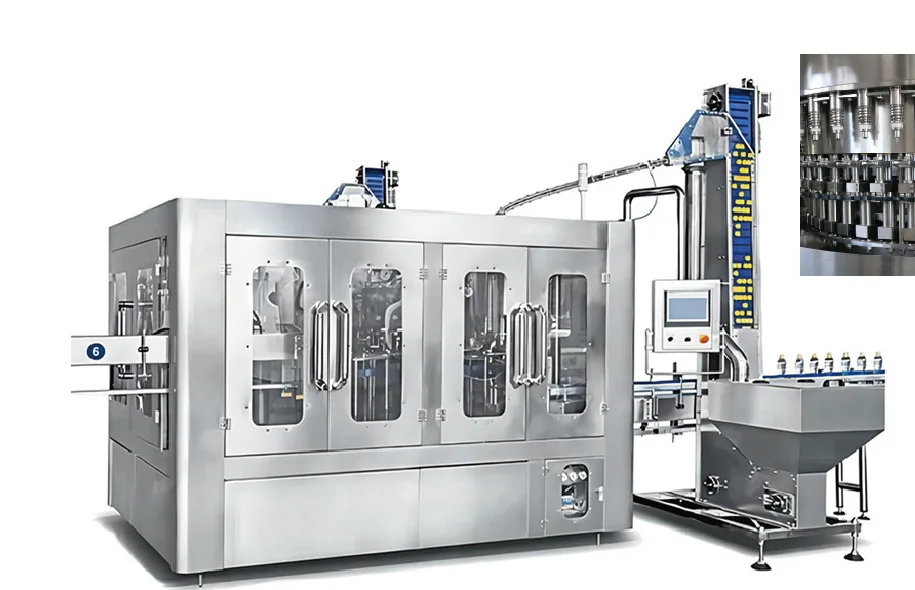
Rinse-fill-cap center
State filler BPH with the reference bottle, product, cap, test window and accepted-output counting point.
Review this interface basis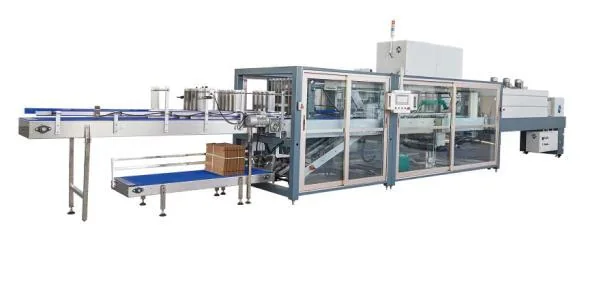
End-of-line packing system
The packer is one connected capacity node; pack pattern, cycle, bottle behavior and discharge flow set the usable rate.
Review this interface basisSource: Allot Tech Beverage Bottling Catalog 2026. Images are representative equipment references; final models and configurations remain project-specific.
Questions before specification
Frequently asked questions
Answers are planning guidance. Project requirements and performance remain subject to confirmed data and agreements.
Must a water bottling flow include on-site bottle blowing?
No. A project may receive purchased empty bottles or produce them on site. Compare the actual supply continuity, container handling, utilities and approved bottle basis before selecting the route.
Is the sequence in every process diagram identical?
No. Product requirements, package and equipment arrangement determine the applicable preparation and inspection steps and the positions of labeling and coding. Confirm the actual project route.
Where should complete-line output be counted?
At the agreed accepted-output boundary after the included operations. State the unit, SKU, period and quality treatment; counts from another stage cannot automatically replace that result.
Next buyer step